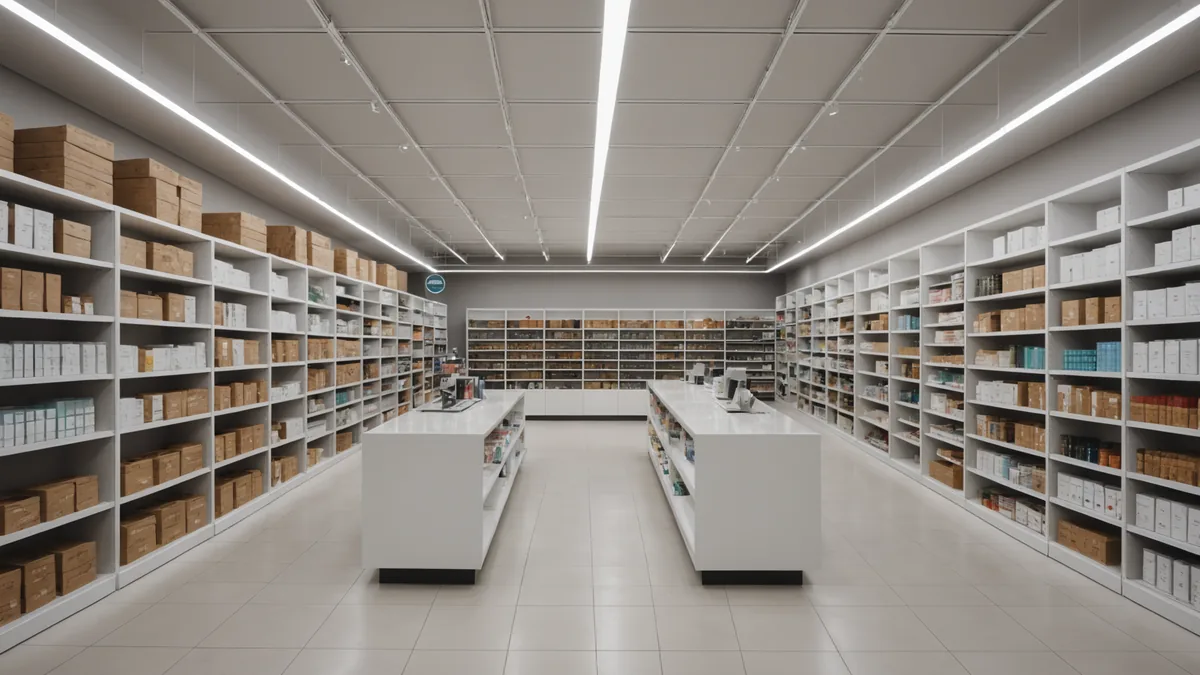
In our early-access pilot cohort, stores responded to restock conditions 31% faster than they had against their own pre-pilot baselines. That result matters less as a headline than as an operating signal: camera analytics is becoming useful when it shortens the distance between an empty shelf, an alert, and a completed action.
Across regional grocery, convenience, and pharmacy operations, we are seeing the same shift. Camera analytics is moving beyond isolated proof-of-concept projects and into repeatable store routines. The deployments that stay in production are not the ones with the most ambitious dashboards. They are the ones that fit the manager's day, work with existing infrastructure, and produce measurements that operations teams can act on.
At Youtiligent, our small team works directly on that problem. We connect to existing ONVIF-compliant cameras, process video on-site, and read shelf-fill rates, out-of-stock conditions, loss-detection patterns, and planogram compliance from live feeds. The system sends detection events and metadata outside the store network, while video frames remain locally processed. That architecture and operating model have shaped what we think regional chains are getting right in 2026.
The useful unit is an operational decision
A shelf alert is only valuable if it changes what happens next. A store manager does not need another stream of observations. They need to know which aisle requires attention, how urgent the condition is, and whether the issue was resolved.
Consider a regional grocery chain with several stores experiencing recurring gaps in chilled beverages during busy afternoon periods. A manual audit may identify the problem later in the shift, after a customer has already encountered the empty space. A camera system can detect a declining shelf-fill condition from the existing feed and notify the relevant team while the shift still has time to respond. The important output is not a confidence score by itself. It is a prioritized work item tied to a shelf zone.
This distinction changes deployment design. We spend time with operations teams defining alert thresholds, escalation rules, and the evidence needed to close an event. A store does not need an alert for every temporary gap caused by a customer reaching for a product. It may need an alert when a section remains below its expected fill level for a defined period, or when a planogram deviation persists across repeated observations.
The same principle applies to compliance. A planogram score is more useful when it shows where drift is concentrated and whether the score is improving after a reset. In our early-access pilot program, the cohort recorded an 18-point lift in planogram compliance over a four-week pilot window. The operational value came from turning a periodic review into a trend that teams could inspect during the workweek.
Existing cameras are an adoption advantage
Regional chains rarely have the budget or appetite to install a new sensor at every shelf. They already have cameras for security, loss prevention, and general store visibility. The practical question is whether those cameras can provide enough usable coverage for an operations workflow.
ONVIF compatibility gives us a concrete starting point. Profile S supports basic streaming, while Profile T supports capabilities including H.264 or H.265 and HTTPS or TLS. Cameras from manufacturers such as Axis, Hikvision, Dahua, Hanwha, Bosch, Uniview, Pelco, and Sony may support ONVIF, although the exact model, firmware, configuration, and available stream still need to be checked.
That last qualification is important. A camera being present on a ceiling does not mean it is automatically suitable for shelf analysis. We assess field of view, mounting angle, resolution, glare, occlusion, aisle geometry, and whether the relevant shelf faces are visible during normal trading. In some stores, a small configuration change is enough. In others, a particular zone is simply not observable from the installed camera position.
Edge processing also affects the deployment conversation. Youtiligent processes video frames locally and sends only detection events and metadata beyond the store network. This reduces the need to move continuous video to a remote environment and gives the store's network team a clearer boundary to review. No new hardware is required for the product's camera connection model, though the existing camera environment still has to meet the practical requirements of the use case.
Three approaches, three different strengths
The debate between shelf vision, weight sensors, and manual audits is often framed as if one method must replace the others. In practice, each approach measures a different part of the problem.
| Approach | What it does well | Where it needs care |
|---|---|---|
| Camera analytics | Observes visible shelf conditions across multiple products and zones without adding a device to each shelf. | Depends on camera placement, visibility, lighting, and interpretation of temporary or partial gaps. |
| Weight sensors | Measures product mass directly in a configured location and can detect changes that are difficult to see. | Requires shelf-level hardware, calibration, maintenance, and a decision about how to handle product variation. |
| Manual audits | Captures context that an automated system may miss, including packaging damage, substitution, cleanliness, and unusual exceptions. | Is periodic, labor-intensive, and difficult to standardize across stores and shifts. |
For regional chains, shelf vision is now a mature option for visible conditions such as shelf fill and planogram alignment. It is particularly useful when a chain wants broad coverage without installing and maintaining a sensor at every location. Weight sensors remain valuable where direct quantity measurement is essential, where visibility is poor, or where a tightly controlled fixture justifies the hardware. Manual audits remain necessary for judgment-heavy checks and for validating whether an automated signal reflects the real store situation.
The strongest operating model is usually a division of labor. Cameras identify where attention is needed. Sensors can provide direct measurement in selected categories. People investigate exceptions, resolve conditions, and improve the underlying process. Treating the methods as competitors can lead to an expensive and brittle design.
What the technology does not see
Camera analytics does not know every reason a shelf is empty. An out-of-stock appearance may reflect replenishment delay, a merchandising decision, a product temporarily held in the back room, or a camera view blocked by a cart or customer. It can identify a visible condition and a pattern over time. It cannot, by itself, assign responsibility or explain the full cause.
Coverage also has physical limits. A low-mounted camera may miss the back of a deep shelf. Glare can reduce visibility on packaging. A promotional display can obscure the permanent planogram. Store remodeling, seasonal fixtures, and changed camera angles can affect the quality of a comparison. These are not problems that a model update alone solves.
We therefore treat deployment as a measurement exercise, not a switch that gets turned on once. Before a pilot, we define the zones, conditions, and response times that matter. During the pilot, we review false alerts, missed conditions, and the way store teams use the events. The 94% alert accuracy rate from our pilot cohort is useful in that context, but it is not a universal guarantee for every store, camera, or category.
There are also decisions the system should not make. It should not automatically discipline an employee because a shelf condition persisted. It should not infer intent from a loss-detection pattern. It should not become a substitute for a manager who understands staffing, deliveries, promotions, and local customer behavior. The right role is to make relevant evidence available earlier and in a form that can be checked.
What the deployments that stick have in common
The pattern we keep seeing is that successful deployments start with a narrow operational question. A 22-store convenience operator may begin with high-frequency beverage and snack zones rather than attempting to score every shelf in every store. A pharmacy group may begin with planogram compliance in a defined set of fixtures. A grocery chain may focus first on the replenishment windows where an empty shelf has the clearest revenue consequence.
That focus makes the baseline credible. Regional chains are often estimated to lose 1% to 3% of daily revenue per store to unaddressed out-of-stock conditions, but a chain should not assume that range describes its own exposure. We prefer to compare a store against its own pre-pilot behavior, with agreed definitions for response time, alert accuracy, shelf-fill condition, and compliance.
Teams also need a clear owner for each event. If an alert enters a shared inbox that nobody monitors, better detection will not improve the shelf. The operational design should specify who receives the event, how it is acknowledged, when it is escalated, and how resolution is recorded. In our experience, this is where many pilots either become a store routine or quietly disappear.
Finally, the system has to earn trust at the aisle level. Managers will test an alert against what they can see. They will notice if a recurring false positive is not corrected. They will also notice when a signal helps them find a condition before a customer complaint or a manual walk. Accuracy is important, but so are explainability, appropriate thresholds, and a workflow that respects the pace of a live store.
The practical benchmark for 2026 is not whether a regional chain has installed camera analytics. It is whether the chain can show that a visible shelf condition was detected earlier, routed to the right person, and resolved more consistently than before. That is the point at which video stops being background infrastructure and starts becoming an operating measurement.
If you are building the internal case for a shelf-intelligence deployment, we are happy to share the measurement framework we use before pilots start. Contact us at [email protected].
Back to Store Ops Insights